Best GPS Dog Fence Collars in 2026: Halo vs SpotOn vs PetSafe (Honest Picks)
PetGearPal is reader-supported. If you buy through links on this page, we may earn a commission at no extra cost to you. As an Amazon Associate, we earn from qualifying purchases.
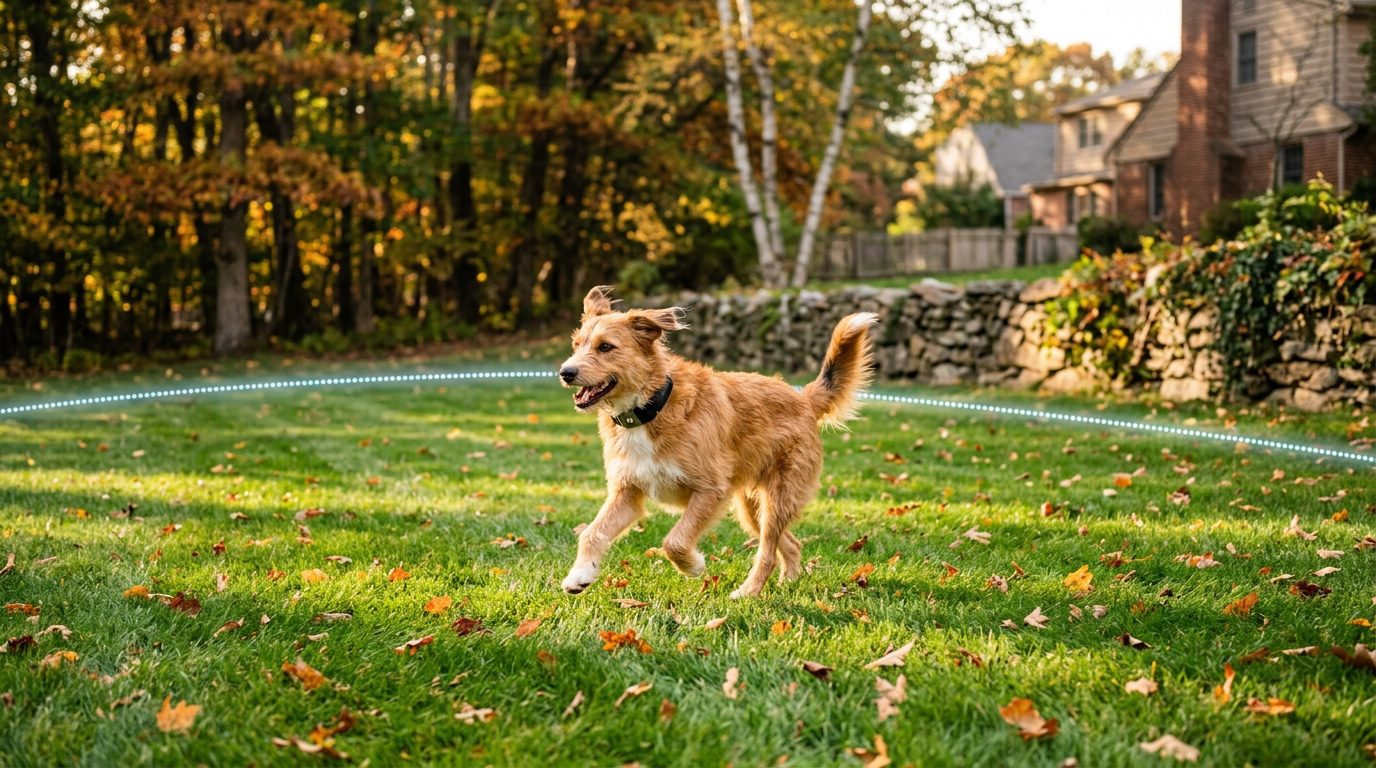
A GPS dog fence lets you draw a boundary on your phone instead of digging a trench or building a physical fence. When it works, it’s the closest thing to off-leash freedom you can give a dog at home. When it doesn’t, it’s an expensive collar that beeps at your dog while he’s napping by the window.
I’ve owned dogs my whole life, and anyone who’s done that has had at least one who treats the property line as a suggestion. So I went through the specs, the subscription fine print, and hundreds of owner reviews of every major GPS fence to figure out which ones actually hold a boundary and which ones cause headaches.
The short answer: Halo Collar 5 is the best GPS dog fence for most suburban yards. SpotOn is the pick if you have a third of an acre or more and hate subscriptions. PetSafe Guardian GPS 2.0 is the best value and the best fit for smaller dogs.
Quick Picks
- Best overall for suburban yards: Halo Collar 5. Works on yards as small as 30×30 ft. View on Amazon →
- Best for acreage, no subscription: SpotOn GPS Fence (Nova or Omni). View on Amazon →
- Best value and best for small dogs: PetSafe Guardian GPS 2.0. Fits dogs from 10 lbs. View on Amazon →
- Best budget alternative (not GPS): PetSafe Stay & Play Compact Wireless Fence. View on Amazon →
GPS Dog Fence Comparison
| Halo Collar 5 | SpotOn Nova / Omni | PetSafe Guardian GPS 2.0 | PetSafe Stay & Play Compact | |
|---|---|---|---|---|
| Price (at time of writing) | $524 | $999 / $899 | about $344 on Amazon | $250 |
| Subscription | Required (from $9.99/mo) | Optional (tracking only) | Required | None |
| Smallest yard | 30×30 ft | 1/3 acre | 1/2 acre | Circle up to 3/4 acre |
| Smallest dog | Neck 8″ and up | 15 lbs, neck 10″ | 10 lbs, neck 8″ | Check collar size chart |
| Saved fences | Unlimited | Unlimited (one active on collar) | Up to 50 | 1 (fixed circle) |
| Real-time tracking | Yes | With plan | Yes | No |
| Works away from home | Yes | Yes | Yes | No |
Specs come from each manufacturer. Prices and ratings were accurate at the time of writing and change often.
What a GPS Dog Fence Actually Does (and Doesn’t Do)
A GPS fence collar knows where your dog is from satellites. You draw a boundary in an app, and as your dog approaches it, the collar gives a warning tone, then vibration, then (if you allow it) a static correction. Most collars let you turn static off entirely.
What it doesn’t do is physically stop anything. It won’t keep other dogs, coyotes, or kids out. It won’t stop a dog who’s decided the squirrel is worth it. And every GPS fence, no matter what the marketing says, has some “drift”: moments where the collar thinks your dog is a few feet from where he really is.
That’s why the training matters more than the collar. Every brand on this list includes a training program, and the dogs that do best are the ones whose owners spent two or three weeks teaching the tone before ever relying on it.
GPS fence vs GPS tracker: A tracker like Fi or Tractive tells you where your dog went after he left. A GPS fence tries to stop him from leaving. If your dog only escapes occasionally, a tracker may be all you need. See our guide to the best GPS trackers for dogs.
The Best GPS Dog Fence Collars in 2026
1. Halo Collar 5: Best Overall for Suburban Yards
(3.8★ · 160+ reviews at the time of writing) View on Amazon →

Halo’s big advantage is size, both the collar’s and the yard’s. It supports fences as small as 30×30 ft, while SpotOn recommends at least a third of an acre and PetSafe half an acre. Halo says the collar weighs about 4.6 oz and fits necks from 8 to 30.5 inches, so it works on more dogs than SpotOn.
Halo also leans hardest into training. The app includes a structured boundary program developed with Cesar Millan, and the collar reads which direction your dog is moving. If he turns back toward home, the feedback stops and the collar plays a “come back” cue. That’s the right way to teach a boundary.
Halo claims up to 48 hours of battery life and sub-2-foot accuracy with its Precision+ correction service. Treat those as manufacturer numbers; real-world battery life depends on how much your dog moves and how often you check the app.
Joe’s take: If you’re on a normal suburban lot (and here in the Northeast, plenty of us are on lots well under an acre), Halo is the only GPS fence on this list that’s designed for your yard. Everything else assumes you have room to spare.
Best for: Suburban yards, smaller properties, first-time GPS fence owners who want a structured training plan.
Skip it if: You refuse to pay a monthly fee. The collar does nothing useful without a plan.
The honest downside: The Amazon rating is the lowest of the premium options here. The complaints that repeat are false alerts inside the fence that start after a few weeks, and collar clips that loosen on active dogs. Halo’s 90-day satisfaction guarantee is your safety net, so set it up and test it hard in the first month.
Two-year cost: about $735–$765 including the required plan.
2. SpotOn GPS Fence (Nova or Omni): Best for Acreage, No Subscription Required
Nova: (4.0★ · 130+ reviews at the time of writing) View on Amazon →
Omni: (4.0★ · 480+ reviews at the time of writing) View on Amazon →
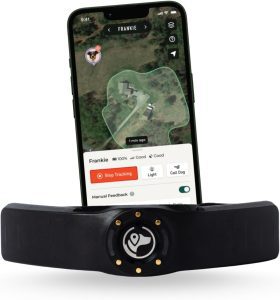
SpotOn is the only premium GPS fence that holds a boundary with no subscription at all. You buy the collar, draw your fences, and you’re done. The optional plan (around $10 a month) adds live tracking, escape alerts, and a recall button in the app.
It’s built for land. SpotOn recommends at least a third of an acre, with the fence at least 80 feet wide at its narrowest point. Owners on 5, 30, even 100+ acres make up a big share of its reviews, and the most consistent praise is that it holds a boundary under heavy tree cover. SpotOn is also designed and assembled in Manchester, New Hampshire, and was named the AKC’s official GPS collar in 2026.
The Nova is the newer model, with better accuracy, voice commands, and activity tracking. The Omni is $100 cheaper and still has the bigger review history.
Joe’s take: If you’ve got a wooded Northeast property with stone walls instead of fences, SpotOn is the one that was built for exactly that. Pay once and skip the monthly bill.
Best for: Large or wooded properties, rural homes, owners who don’t want a required subscription.
Skip it if: Your yard is under a third of an acre, or your dog weighs less than 15 lbs.
The honest downside: Battery life and price. Several owners report getting 12–24 hours on a charge, well short of the claimed 33+, which means charging every night. A recurring complaint is false alerts or corrections indoors or where cell service is weak; SpotOn’s “Home Zone” feature exists to fix this, so set it up on day one. And at $899–$999, out-of-warranty repairs after the first year sting.
Two-year cost: $899–$999 with no plan; roughly $1,140–$1,240 with tracking.
3. PetSafe Guardian GPS 2.0: Best Value and Best for Small Dogs
(3.5★ · 210+ reviews at the time of writing) View on Amazon →
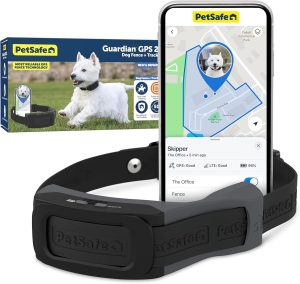
PetSafe’s Guardian 2.0 costs well under half of SpotOn and fits dogs from 10 lbs with necks as small as 8 inches. PetSafe says the collar weighs just 3.7 oz. It stores up to 50 fences, uses dual-frequency GPS, and gives you tone, vibration, and 10 levels of static.
A subscription is required (monthly or annual, with a one-month free trial). If you have a Costco membership, look for the Guardian 2.0 bundle that includes a two-year subscription code. At the time of writing it was listed around $390, which makes it the cheapest way into a real GPS fence.
Joe’s take: This is the one I’d point a small-dog owner toward, and the one I’d buy if I wanted to see whether a GPS fence works for my dog without betting $900 on it.
Best for: Dogs from 10 to 30 lbs, half-acre-plus yards, budget-conscious buyers.
Skip it if: Your yard is under half an acre, or you need the tightest possible boundary near a busy road.
The honest downside: It has the weakest Amazon rating of the GPS options. The complaints that repeat are lag in live tracking, a collar strap that loosens and needs re-tightening, and units failing a few months in. Buy it somewhere with an easy return window and test it hard early.
4. PetSafe Stay & Play Compact: Best Budget Alternative (Not GPS)
(4.0★ · 6,700+ reviews at the time of writing) View on Amazon →

This isn’t a GPS fence, and it’s worth knowing why it’s here. The Stay & Play uses a base station that plugs in inside your house and broadcasts a circular boundary up to 3/4 acre. No satellites, no subscription, no app.
The tradeoff is flexibility. The boundary is always a circle centered on the base station, so it won’t match an odd-shaped lot, and it doesn’t travel with you. But it’s $250, it’s been on the market for years, and it has thousands more reviews than any GPS fence.
Best for: Open, roughly square yards; owners who want containment for the lowest cost and no monthly fee.
Skip it if: Your yard is long and narrow, borders a road on one side, or you want to use it at a campsite or a relative’s house.
The honest downside: The circle. If your house sits near one edge of your property, the circle either spills into the road or cuts off half your yard.
How to Choose the Right GPS Dog Fence
1. Measure your yard first. This decides most of it. Under a third of an acre, Halo is your only GPS option. Between a third and a half acre, it’s Halo or SpotOn. Over half an acre, all three work.
2. Look at your trees. GPS signals weaken under dense canopy and near tall buildings. SpotOn and Halo both market their tree-cover performance hardest. Whichever you buy, set your boundary 10–15 feet inside anything dangerous, like a road.
3. Decide how you feel about subscriptions. Over two years, Halo’s required plan adds about $240. SpotOn costs more up front but nothing after. Run the numbers for the number of years you expect to use it.
4. Check your dog’s size. SpotOn needs 15 lbs and a 10-inch neck. Halo and PetSafe Guardian 2.0 go down to an 8-inch neck.
5. Check your cell coverage. Fences work from GPS alone, but tracking, escape alerts, and app control need cellular service. If your phone struggles in your yard, the app will too.
6. Plan for winter. Cold drains lithium batteries faster, and you’ll want the collar charged every night from December through March. Thick winter coats can also keep contact points from reaching the skin; every brand includes longer contact points for long-haired dogs.
What I’d Buy
For a typical suburban yard, I’d buy the Halo Collar 5 and use the 90-day guarantee to make sure it holds a boundary on my property. If I had acreage and woods, I’d buy the SpotOn Omni, skip the subscription, and spend the $100 I saved over the Nova on a spare charging cable. And if I had a 15-pound terrier and a half-acre lot, I’d start with the PetSafe Guardian GPS 2.0 from Costco.
Whichever you choose, train first. Two or three weeks of short daily sessions on a leash, teaching your dog what the warning tone means, is the difference between a fence that works and an expensive collar.
GPS Dog Fence FAQ
Do GPS dog fences really work? Yes, for most dogs that are properly trained to the warning tone. SpotOn reports that trained dogs stay inside their boundary 99.3% of the time they’re outdoors. They work less well for dogs with very high prey drive, and no GPS fence is a substitute for a physical fence near a busy road.
Do GPS dog fences shock dogs? Most offer static correction, but it’s optional on all three GPS fences here. Halo, SpotOn, and PetSafe all let you use tone and vibration only. Many trainers recommend starting there; dogs that learn the tone well rarely get a correction.
Which GPS dog fence has no monthly fee? SpotOn. Fences work without a subscription; the optional plan adds tracking and alerts. Halo and PetSafe Guardian GPS 2.0 both require a plan.
What’s the smallest yard a GPS dog fence works in? Halo supports fences as small as 30×30 ft. SpotOn recommends at least 1/3 acre and PetSafe Guardian 2.0 at least 1/2 acre.
Can a GPS dog fence work in the woods? Yes, but accuracy drops under heavy tree cover. SpotOn and Halo both have features built for wooded properties. Give yourself a wider buffer from roads.
Halo or SpotOn: which is better? Halo for smaller yards, smaller dogs, and owners who want a guided training program. SpotOn for big or wooded properties and owners who don’t want a subscription.
Will a GPS fence keep other animals out? No. A GPS fence only keeps your dog in. If coyotes or loose dogs are a concern, supervise outdoor time.
Related reading: Best GPS Trackers for Dogs | Best No-Pull Dog Harnesses | How to Stop a Dog From Barking | Best Pet Insurance for Dogs