How to Stop a Dog From Barking: What Actually Works
PetGearPal is reader-supported. If you buy through links on this page, we may earn a commission at no extra cost to you. As an Amazon Associate, we earn from qualifying purchases.
Last updated: July 2026 | ~2,000 words

Not All Barking Is the Same Problem — and the Fix Depends on Which One You Have
Learning how to stop a dog from barking starts with understanding why they bark. Dogs bark — that’s not the problem. The problem is when barking becomes excessive, compulsive, or uncontrollable — when your dog barks at every noise outside, barks for hours when left alone, or can’t stop even when you’re right there.
The most common mistake people make when trying to stop excessive barking is treating it as a single problem with a single fix. It isn’t. A dog who barks from fear needs a completely different approach than a dog who barks for attention or a dog who barks from boredom. Using the wrong approach doesn’t just fail — it often makes things worse.
This guide breaks down the main types of barking, what actually works for each, and the methods that are widely promoted but genuinely don’t help.
When barking is a symptom of anxiety: If your dog barks excessively when left alone, reacts to sounds with panic, or seems generally unable to settle, anxiety may be the root cause — and that often requires more than training. A Dutch telehealth vet can assess whether medication alongside behavioral work is the right approach.
Why Dogs Bark: The 6 Main Types
Understanding why your dog is barking is the first step to fixing it. Each type has different triggers, different emotional states driving it, and different solutions.
1. Alert/Territorial Barking
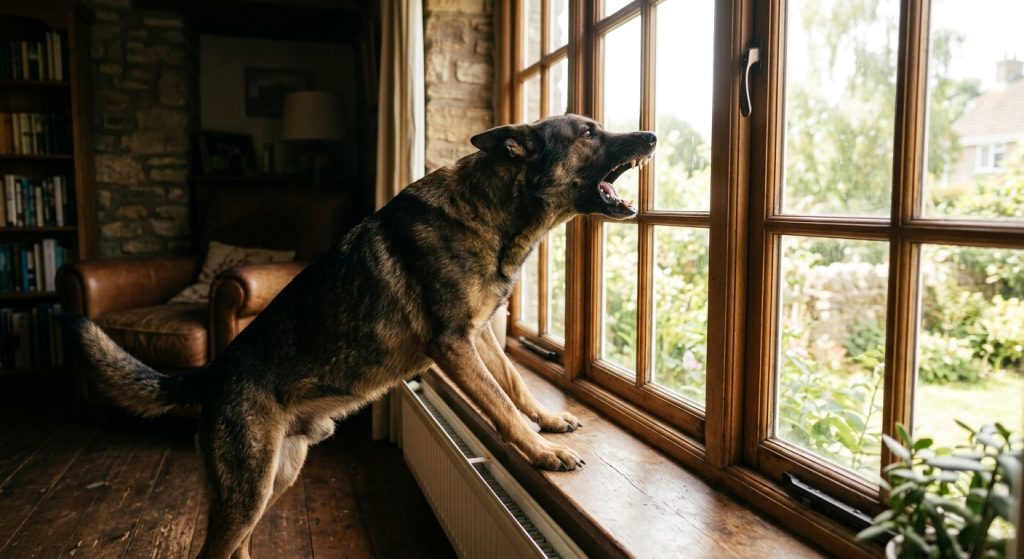
What it looks like: Your dog barks at anything that moves past the window, at the doorbell, at strangers approaching the yard. The barking typically starts sharp and intense and may settle once the “threat” passes.
What’s driving it: An instinct to alert the pack to potential threats. Some breeds (terriers, hounds, herding breeds) were specifically selected for this trait and have it in abundance.
2. Demand/Attention Barking
What it looks like: Your dog barks at you directly — for food, for play, to be let in or out, or simply for interaction. The barking is typically sustained, repetitive, and stops when they get what they want.
What’s driving it: Learned behavior. At some point, barking worked — they got attention, food, or a door opened — and they kept using it.
3. Separation Anxiety Barking
What it looks like: Barking begins within minutes of you leaving and often continues for extended periods. Usually paired with other distress signs — pacing, destruction, elimination. Neighbors often report this to owners who aren’t there to observe it.
What’s driving it: Genuine distress at being separated from the owner. Not bad behavior — a behavioral condition.
4. Fear/Reactive Barking
What it looks like: Triggered by specific stimuli — other dogs, strangers, loud sounds, unfamiliar environments. The barking often looks aggressive but is usually driven by fear. Many “reactive” dogs are anxious dogs who bark as a distance-increasing behavior.
What’s driving it: Fear, insufficient socialization, or a negative experience with the trigger.
5. Boredom/Frustration Barking
What it looks like: Sustained, often monotonous barking with no clear external trigger. Common in dogs left alone for long periods without sufficient mental or physical stimulation.
What’s driving it: Under-stimulation. Dogs need things to do — when they don’t have them, some bark.
6. Excitement Barking
What it looks like: High-pitched, rapid barking when greeting people, before walks, or during play. Usually brief.
What’s driving it: Arousal. Less problematic than other types but can escalate in high-drive dogs.
How to Stop a Dog From Barking: What Works, by Type
For Alert/Territorial Barking
Management first: The single most effective immediate intervention is removing visual access to the trigger. A dog that can’t see every person walking past your front window can’t bark at them. Frosted window film on lower panes, baby gates that keep the dog out of front-facing rooms, or simply closing blinds during peak activity hours can produce an immediate dramatic reduction without any training.
Teach an incompatible behavior: Train a rock-solid “place” or “go to mat” cue that you can use when alert barking starts. A dog lying on their mat cannot be simultaneously barking at the window. This takes consistent training with high-value rewards — our guide to the best dog training treats covers what makes a treat high-value enough to compete with the arousal of territorial barking.
Counter-conditioning: Pair the trigger (doorbell, person outside) with something the dog loves. Over time the trigger predicts good things rather than alerting danger. This works well for dogs whose alert barking has an anxious quality.
For Demand/Attention Barking
Extinction (with patience): Demand barking is maintained by reinforcement — every time the dog barked and got something, the behavior strengthened. Removing all reinforcement for barking and rewarding silence is the correct approach. The critical rule: never give in while barking is happening. If you’ve been giving in and now stop, expect an “extinction burst” — the barking gets dramatically worse before it improves, as the dog escalates trying to get what used to work. This is temporary. Hold firm.
Reinforce incompatible behavior: Reward heavily when the dog is quiet and relaxed. Give attention, food, or play proactively when they’re not demanding it, so they learn that quiet is actually the more reliable path to good things.
For Separation Anxiety Barking
This is the most complex type and usually requires the most structured approach. The core intervention is systematic desensitization — building up tolerance to alone time from essentially zero, far too gradually for most owners’ patience, but at a pace the dog can succeed at.
Important: Punishment, bark collars, and other suppression approaches are specifically contraindicated for separation anxiety barking. They add an additional threat to an already-distressed dog and typically make anxiety worse.
For dogs with significant separation anxiety, behavioral medication is often appropriate. SSRIs like fluoxetine take 4–6 weeks to reach full effect but significantly reduce baseline anxiety, making behavioral work more effective. A Dutch telehealth vet can assess and prescribe these without requiring an in-person visit. Our guide to calming an anxious dog covers the full behavioral framework for separation anxiety in detail.
For Fear/Reactive Barking
Increase distance from triggers: Reactive barking typically has a threshold — below a certain distance to the trigger, the dog can function; above it, they can’t. Identify that threshold and stay under it during training sessions.
Counter-conditioning and desensitization: Pair trigger appearances at sub-threshold distance with high-value food. Gradually, systematically reduce distance as the dog’s emotional response improves. This process takes weeks to months for established reactivity, not days.
Management in the meantime: A well-fitted front-clip harness reduces pulling toward triggers and gives you more control during encounters. Avoid situations above threshold — forcing reactive dogs into overwhelming environments sets training back significantly.
For Boredom/Frustration Barking
More enrichment, not more exercise: The instinct is to tire the dog out physically. For many boredom barkers, this actually increases arousal over time. What works better is mental enrichment — puzzle feeders, sniff walks, training sessions, food-dispensing toys. A dog that has had to problem-solve is genuinely more settled than one who has simply run in circles.
Structured alone-time enrichment: Provide high-value, long-lasting enrichment specifically for alone time — frozen Kongs, lick mats, bully sticks — so that alone time predicts good things rather than nothing.
For Excitement Barking
Withhold what they want until quiet: If your dog barks before walks, the leash doesn’t go on until they’re quiet. If they bark at guests, the greeting doesn’t happen until calm. Consistently pairing the thing they want with the absence of barking teaches them that calm behavior is what unlocks the good stuff.
What Doesn’t Work
Yelling “quiet” or “no”: To a barking dog, you’re joining in. Attention of any kind — including negative attention — reinforces demand barking. Raising your voice during alert barking can increase arousal.
Bark collars (shock, citronella, ultrasonic): Widely used but generally ineffective for the underlying cause and specifically harmful for anxiety-driven barking. Suppressing the behavioral symptom while the emotional state remains unchanged doesn’t resolve the problem — it often just produces a dog that’s more anxious and now also afraid of their collar. Not recommended.
Letting them “bark it out”: Works only if the behavior is truly demand/attention barking and you can maintain complete non-reinforcement. For anxiety or fear-based barking, the dog doesn’t “tire out” — they remain in distress.
Squirt bottles, loud noises, startling the dog: Aversive interruption methods suppress barking in the moment but don’t address the underlying motivation. They can also damage trust and increase fear in dogs who are already anxious.
When to Get Professional Help
Consider a veterinary behaviorist or certified applied animal behaviorist if:
- The barking is severe enough to risk your housing situation or neighbor relationships
- The dog shows aggression alongside reactive barking
- You’ve been working consistently for 6–8 weeks without meaningful improvement
- Separation anxiety is involved and behavioral modification alone isn’t working
A Dutch telehealth vet is a good first step for assessing whether medication would help — particularly for anxiety, fear-based, or separation-related barking — before committing to a specialist appointment.
Before the FAQ: Related Reading
If separation anxiety is driving the barking, our guide to calming an anxious dog covers the full behavioral and pharmacological toolkit for anxiety in dogs. For dogs whose barking is connected to under-stimulation, our guide to how much exercise your dog actually needs covers enrichment and exercise calibrated by breed and age. And if your dog’s reactive barking happens on walks with pulling and lunging, our best no-pull dog harnesses guide covers the equipment that gives you more control during reactive encounters.
FAQ
Q: My dog only barks when I’m not home. How do I fix something I can’t observe? Set up a camera (many affordable options via Amazon) to observe what’s actually happening and when the barking peaks. This tells you whether it starts immediately (classic separation anxiety) or builds over time (boredom). The distinction matters for which approach you take. Share footage with your vet or a behaviorist.
Q: Will getting a second dog stop the barking? Rarely. For separation anxiety, the distress is about the absence of a specific person, not about being alone in general. A second dog doesn’t replace that. For boredom barking, a compatible companion sometimes helps — but adds significant responsibility and sometimes adds a second barking dog.
Q: My dog barks at night. What can I do? Night barking usually has one of two causes: a stimulus outside (animals, sounds) or anxiety about being alone in the dark. For stimulus-driven night barking, white noise near the dog’s sleeping area can mask outdoor sounds effectively. For anxiety-related night barking, moving the dog’s sleeping location closer to you often resolves it immediately — distance from the owner is the trigger.
Q: Are there breeds that are genuinely harder to stop barking? Yes. Beagles, Basset Hounds, and other scent hounds were bred to bark while tracking. Terriers have high alert instincts. Nordic breeds like Huskies vocalize extensively. This doesn’t mean training won’t work, but realistic expectations are appropriate — some breeds need ongoing management and enrichment rather than a “fixed” state.
Q: How long will this take? For demand barking addressed with consistent extinction: 1–3 weeks if you’re consistent. For alert barking with management plus training: noticeable improvement in 2–4 weeks, full reliability in 2–3 months. For separation anxiety or fear-based barking: months of consistent work, and often ongoing management. Medication for anxiety-related barking typically begins showing effect after 4–6 weeks.
Q: Can I teach an older dog to stop barking? Yes. Learning doesn’t have a cutoff by age. Older dogs may learn slightly more slowly and long-established habits take longer to change, but all of the techniques above work regardless of the dog’s age.