Best Dog Anxiety Vest in 2026: What Actually Works (and What Doesn’t)
PetGearPal is reader-supported. If you buy through links on this page, we may earn a commission at no extra cost to you. As an Amazon Associate, we earn from qualifying purchases.
Thunderstorms. Fireworks. Car rides. The doorbell. Separation. Some dogs are anxious about one trigger; others seem anxious about everything. If your dog trembles, paces, pants, hides, or goes into full panic mode, you’ve probably looked into anxiety vests — and then wondered whether they actually do anything.
The honest answer: for many dogs, they work. Not as a cure, and not every time — but a well-fitted pressure wrap can meaningfully reduce anxiety behaviors in dogs who respond to deep pressure, which research suggests is a real and effective calming mechanism. This guide covers the best dog anxiety vests in 2026, what the science actually says, and how to pick the right one for your dog.
Do Dog Anxiety Vests Actually Work?
Pressure wraps for dogs are based on the same principle as weighted blankets for humans: sustained, gentle pressure on the torso activates the parasympathetic nervous system, reducing cortisol and promoting calm. In dogs, this is sometimes called “maintained pressure therapy.”
The research is genuinely mixed — some studies show measurable reductions in stress behaviors (trembling, panting, vocalization), while others show limited effect compared to no intervention. A 2014 study in the Journal of Veterinary Behavior found ThunderShirt use significantly reduced heart rate variability in dogs during thunderstorm-related anxiety. Skeptical vets point out that placebo effect (in the owner, not the dog) can’t be fully controlled for.
What’s clear from both research and real-world owner reports: pressure wraps work well for a meaningful subset of dogs — often 60–70% of owners report improvement, especially for situational anxiety (thunderstorms, fireworks, car travel). They work less reliably for generalized anxiety or separation anxiety, where behavior modification and sometimes medication are more appropriate tools.
The bottom line: for situational anxiety, an anxiety vest is worth trying. It’s non-invasive, low-risk, and if it works for your dog, it works quickly — sometimes within the first use.
What to Look For in a Dog Anxiety Vest
Fit Over Everything
A vest that’s too loose does nothing. Pressure wraps work through sustained, gentle compression against the torso — if it can shift around freely, the mechanism fails. Most brands offer sizing by chest circumference; measure your dog’s chest at its widest point before ordering.
Ease of Application During a Panic
If your dog is already spiraling, fumbling with clips and buckles makes things worse. The best anxiety vests go on in 15–20 seconds with a simple wrap-and-fasten system. Practice putting it on during calm moments so it becomes a neutral cue.
Breathable Materials
Dogs wear these during high-stress moments — often in warm weather during July 4th fireworks or during summer storms. Heavy or non-breathable materials will add to rather than reduce stress. Look for soft, lightweight, moisture-wicking fabric.
Machine-Washable
A stressed dog may drool, sweat, or worse. If it’s not machine washable, you’ll use it less.
Best Dog Anxiety Vests in 2026: Our Top Picks
🥇 Pick #1: ThunderShirt Classic (Best Overall)
(4.5★ · 35,000+ reviews) View on Amazon →

ThunderShirt is the category standard for a reason — it’s the most studied, most recommended, and most proven anxiety vest on the market. The Classic design wraps around the torso with hook-and-loop fasteners (Velcro) that let you dial in the fit precisely. No buckles, no clips, no fumbling. Once it’s on, it stays on and maintains consistent pressure.
The patented pressure design applies gentle, constant pressure across the chest, sides, and back simultaneously. ThunderShirt claims an 80% success rate, which is consistent with what veterinarians and owners report anecdotally — though “success” varies from dramatic calming to modest improvement.
Available in sizes XXS through XXL, covering dogs from 7 lbs to over 110 lbs. The Classic comes in Heather Grey, Blue Polo, and Pink Polo. Machine washable.
Best for: Thunderstorms, fireworks, car travel, vet visits, strangers — any situational anxiety. The go-to first choice for most dogs and most situations.
Sizing note: ThunderShirt sizes by weight and chest measurement — use the chest measurement as the primary guide. A dog who falls between sizes should go up, not down.
🥈 Pick #2: ThunderShirt Sport (Best for Active or Athletic Dogs)
(4.5★ · 8,000+ reviews) View on Amazon →
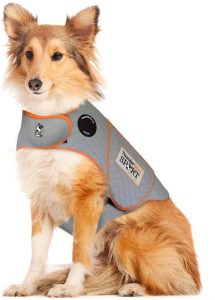
Same ThunderShirt pressure technology, upgraded fabric. The Sport version uses a performance jersey material that’s lighter, more breathable, and dries faster than the Classic — a meaningful upgrade for larger, more active dogs, brachycephalic breeds (Bulldogs, Pugs, Frenchies) who overheat easily, or anyone in a warm climate.
The fit and application are identical to the Classic. The main difference is the fabric: softer hand feel, better airflow, and faster drying after a post-thunderstorm soak. It costs a few dollars more than the Classic.
Best for: Dogs who overheat easily; high-energy breeds; hot climates; dogs who will wear the vest for extended periods.
🥉 Pick #3: AKC Calming Coat (Best Budget Pick)

The AKC Calming Coat applies the same sustained-pressure principle as ThunderShirt at a lower price point. It’s not as precisely engineered or as well-researched as ThunderShirt, but it’s genuinely functional — the wrap-around design covers the chest and back with adjustable hook-and-loop closures, and the fit is reasonably customizable.
Where it falls slightly short of ThunderShirt: the material is a bit thicker and less breathable, and the sizing can run inconsistent (check reviews for your breed). It’s a solid option for owners who want to try a pressure wrap without committing to ThunderShirt’s price, or as a secondary vest to keep in a car or travel bag.
Best for: Budget-conscious owners trying pressure wraps for the first time; backup vest for a second location.
Pick #4: Shed Defender Anxiety + Shedding Vest (Best Dual-Purpose Option)
(4.5★ · 12,000+ reviews) View on Amazon →

The Shed Defender was originally designed to contain shedding, but the full-body compression it provides also functions as an anxiety wrap — and for some dogs, the whole-body coverage works better than a chest-only vest.
It covers the torso, back, and hindquarters entirely, which some dogs (particularly those who respond to full-body pressure rather than chest pressure) find more calming. It’s also onesie-style — no separate fastening required, just stretch it on — which is easier for owners who find wrap-and-fasten designs tricky.
The dual-purpose utility is a genuine advantage for heavy-shedding breeds whose owners are already dealing with fur on furniture. Machine washable, multiple colors, sizes XS through 3XL.
Best for: Heavy-shedding breeds; dogs who haven’t responded to chest-only vests; multi-dog households where one product handles two problems.
What Anxiety Vests Won’t Fix
Anxiety vests are a management tool, not a treatment. They help dogs cope with anxiety-triggering situations — they don’t address the underlying anxiety.
For dogs with severe anxiety (destructive behavior, self-harm, true panic responses), a vest may take the edge off but won’t be sufficient on its own. In those cases, behavior modification (desensitization and counter-conditioning) and sometimes anti-anxiety medication (Trazodone, Fluoxetine, Clomipramine, or situational medications like Sileo or Reconcile) are more appropriate first steps. Talk to your vet.
For separation anxiety specifically, pressure vests have a poor track record — the mechanism that helps during a storm (owner present, situation time-limited) doesn’t translate as well to extended alone time. Separation anxiety usually requires a dedicated behavior modification protocol.
For most situational anxiety — storms, fireworks, travel, vet visits, strangers — a properly fitted vest is worth trying as part of a broader calming strategy that might also include pheromone diffusers (Adaptil), calming supplements, and management of the environment (white noise, safe spaces).
If you want professional guidance without a full vet appointment, Dutch offers veterinary telehealth specifically for pet anxiety — including prescription options that can be shipped to your door.
How to Get the Most Out of an Anxiety Vest
Put it on before anxiety begins. An anxiety vest applied after a dog is already panicking is less effective than one applied proactively. If thunderstorms trigger your dog, put the vest on at the first sign of dark skies or pressure changes — not when the thunder starts.
Practice during calm moments. Dogs who’ve only ever worn the vest during stressful events may start associating the vest itself with anxiety. Put it on occasionally during calm, positive moments (before a walk, before mealtime) to keep the association neutral.
Pair with other calming strategies. Vests work best as part of a toolkit: reduce environmental triggers (white noise to mask thunder), provide a safe enclosed space (a covered crate), use Adaptil spray or a diffuser, and consider calming supplements like L-theanine or melatonin.
Give it 3–5 uses before deciding. Some dogs respond on the first use; others take a few exposures to learn to associate the vest with calming down. Don’t write it off after one thunderstorm.
Anxiety Vest FAQ
How tight should an anxiety vest be? Snug but not restrictive. You should be able to slip two fingers under the wrap, but it should not shift or sag. The pressure should be firm and consistent, not so tight it restricts breathing or movement.
Can my dog sleep in an anxiety vest? For short naps during a storm, yes. For extended overnight wear, no — prolonged compression on any body part can cause discomfort, restrict circulation, or cause skin irritation. Remove the vest once the triggering event has passed.
My dog seems more anxious with the vest on. Is that normal? For a small percentage of dogs, pressure wraps increase anxiety — particularly dogs who are touch-sensitive, have pain somewhere on the body, or have trauma related to restraint. If your dog consistently resists the vest or seems more agitated while wearing it, discontinue use and talk to a vet or veterinary behaviorist.
At what age can I start using an anxiety vest on a puppy? ThunderShirt and most other brands recommend 6 months and up, once a puppy is through the primary socialization period and anxiety patterns are more established. Using it earlier is generally safe but less useful, since puppies’ anxiety responses aren’t yet fully developed.
Does a ThunderShirt work for fireworks anxiety? Yes — fireworks are one of the use cases with the best-reported success rates. Put it on 30 minutes before fireworks are expected to start, use white noise or a TV to mask the sound, and keep your dog in an interior room away from windows.
Related reading: How to Calm an Anxious Dog | Best Dog Calming Treats and Supplements | Best Dog Beds for Anxious Dogs | Best Dog Crates | How to Crate Train a Dog