Best Dog Harnesses for Small Dogs in 2026: Our Top Picks by Size and Breed Type
PetGearPal is reader-supported. If you buy through links on this page, we may earn a commission at no extra cost to you. As an Amazon Associate, we earn from qualifying purchases.
Last updated: August 2026 | ~1,950 words
Small Dogs Need Harnesses More Than Big Dogs Do — and Most Small Dog Owners Are Using the Wrong One
Collars are genuinely more dangerous for small dogs than for large ones. Small breeds — particularly brachycephalic dogs like Pugs and French Bulldogs, and toy breeds like Chihuahuas and Yorkies — have fragile tracheas that can be damaged by even moderate collar pressure. Patellar luxation, a common orthopedic issue in small breeds, can be worsened by the pulling and jerking that often accompanies collar-only walking. And small dogs, as a rule, pull more relative to their body weight than larger dogs, making the forces involved more concerning rather than less.
A well-fitted harness distributes pressure across the chest and shoulders instead of the neck, removes tracheal risk entirely, and gives you far better control over a dog who can slip a collar in a heartbeat.
The challenge: harnesses designed for small dogs are rarely as well-engineered as their large-dog equivalents. Many are too flimsy, too hard to fit correctly, or designed more for aesthetics than function. This guide covers the options that actually work.
What Makes the Best Dog Harnesses for Small Dogs
Fit: The most important factor. Small dogs have extremely variable body proportions — a 10-lb Dachshund and a 10-lb Pug have almost nothing in common anatomically. Look for harnesses with multiple adjustment points (chest and girth at minimum) and measure your dog before ordering rather than going by weight alone.
Step-in vs. overhead: Step-in harnesses (the dog steps their front feet in, you clip the back) are easier to put on dogs who resist having anything pulled over their head. Overhead harnesses (slip over the head, clip under the belly) tend to fit more securely and are harder to escape from. Know your dog’s tolerance for handling.
Front clip vs. back clip vs. dual clip:
- Back clip: Easiest for the dog, comfortable for calm walkers. Less effective for pullers — pulling forward is easier with a back clip.
- Front clip: Redirects a puller toward you when they pull, reducing the behaviour over time. Slightly more management required during walking.
- Dual clip: Both options on one harness. Maximum flexibility.
Escape-proof design: Small dogs are notorious escape artists — a determined Chihuahua or Dachshund can back out of a poorly fitted harness in seconds. Look for designs where the harness wraps the body rather than just sitting on top of it.
Padding: Small dogs have thinner skin and more prominent anatomy than large breeds. Adequate padding at pressure points (chest, armpits) prevents chafing on dogs who wear their harness frequently.
Comparison Table: Best Small Dog Harnesses (2026)
| Harness | Best For | Clip | Size Range | Price |
|---|---|---|---|---|
| Ruffwear Front Range (XS) | Active small dogs, durability | Back + front | XXS–XL | ~$45–55 |
| PetSafe Easy Walk (small) | Pullers, training | Front | XS–M | ~$20–30 |
| Puppia Soft Harness | Step-in ease, brachycephalic breeds | Back | XS–XXL | ~$15–25 |
| Gooby Escape Free | Escape artists, Dachshunds | Back | XXS–L | ~$20–30 |
| Rabbitgoo No-Pull | Budget, everyday use | Front + back | XS–L | ~$15–25 |
Our Top Picks
🥇 1. Ruffwear Front Range Harness (XXS/XS) — Best Overall
View on Amazon → (4.7★ · 28,000+ reviews)

Ruffwear makes the harness that consistently tops large-dog recommendations for good reason — and their smallest sizes translate that quality directly to small dogs. The Front Range has four adjustment points (two on the chest strap, one on each side of the girth), which allows genuinely precise fitting across the range of small breed body types. The padded chest and belly panels are wide enough to distribute pressure properly even on very small dogs.
Two aluminium V-rings (back and chest) give you clip flexibility without the cheap hardware that fails on budget harnesses. The ID tag attachment loops on the chest ring, keeping it visible without adding neck weight. Reflective trim is practical for early morning and evening walks.
The price is real — this is one of the more expensive small dog harnesses — but it’s the harness that fits correctly on a wide range of small breeds, lasts several years without hardware failure, and doesn’t require replacing every season.
Best for: Active small dogs, dogs who’ve escaped other harnesses, owners who want one harness that reliably fits and lasts
🥈 2. PetSafe Easy Walk Harness — Best for Pullers
View on Amazon → (4.5★ · 67,000+ reviews)
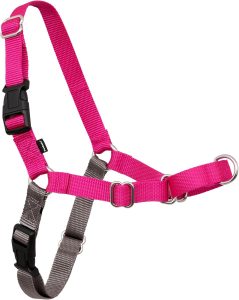
The Easy Walk is specifically designed to address pulling by redirecting the dog toward you when they pull forward — the front chest clip creates a martingale effect that turns the dog’s momentum. For small dogs who pull hard (and many do, relative to their size), this is one of the most immediately effective tools available without requiring formal leash training first.
Fitting is straightforward, with adjustment on the shoulder and belly straps. The neoprene-lined chest strap sits away from the armpits, reducing the chafing that’s common with cheaper front-clip designs. Available in sizes down to extra-small covering most toy and small breeds.
Watch out for: Some dogs learn to step out of it if the fit isn’t snug — size down if between sizes.
Best for: Pullers of any size, owners who want immediate walking improvement, training-alongside use
🥉 3. Puppia Soft Harness — Best for Brachycephalic Breeds and Step-In Ease
View on Amazon → (4.4★ · 32,000+ reviews)
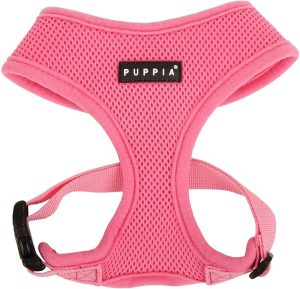
Puppia has been making small dog harnesses for over a decade and their Soft Harness remains the most popular option for brachycephalic breeds (Pugs, French Bulldogs, Shih Tzus, Cavaliers) for good reason: the step-in design, soft mesh construction, and wide chest panel work well on the broad, round body types typical of these breeds where other harnesses gap or shift. Available in an enormous range of sizes and colours.
Not the most escape-proof option for determined wrigglers, and the single back clip limits pulling management. But for calm walkers, flat-faced breeds, or dogs who resist overhead harness fitting, this is the most comfortable and best-proportioned option in the category.
Best for: Brachycephalic breeds, dogs who resist head-through harnesses, calm walkers
4. Gooby Escape Free Harness — Best for Escape Artists
View on Amazon → (4.4★ · 12,000+ reviews)
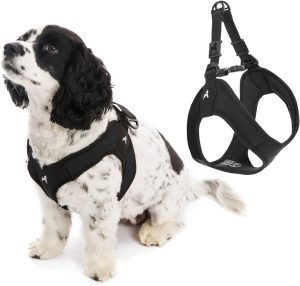
Designed specifically for dogs who back out of standard harnesses, the Gooby uses a wrap-around design that covers the body more fully than most step-in styles, making it significantly harder to escape from. Particularly popular for Dachshunds and Italian Greyhounds — two of the most notorious escape artists in the small dog world — because the design accommodates the long body and narrow chest proportions these breeds have.
Best for: Escape artist small dogs, Dachshunds, dogs with unusual proportions that standard harnesses don’t fit well
5. Rabbitgoo No-Pull Harness — Best Budget Option
View on Amazon → (4.5★ · 100,000+ reviews)
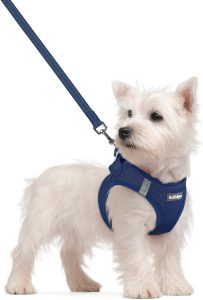
The most reviewed small dog harness on Amazon at this price point. Front and back clips, reflective stitching, and a wide padded chest strap on a sub-$20 price tag. The hardware is adequate rather than impressive and the fit isn’t as precise as the Ruffwear, but for owners who want a functional, everyday harness without a premium price, this consistently delivers. Replace when hardware shows wear — typically 12–18 months of daily use.
Best for: Budget-conscious owners, secondary harness, owners wanting to try front-clip walking before committing to a premium option
How to Measure Your Small Dog for a Harness
Most returned harnesses are the wrong size — and most small dog harnesses are sized by weight, which is unreliable across breeds. Measure instead:
Chest girth: The widest point of the chest, just behind the front legs. This is the most critical measurement.
Neck girth: The base of the neck, where a collar would sit.
Back length: From the base of the neck to the base of the tail (relevant for step-in styles).
When between sizes, go larger for back-clip harnesses (you can always tighten) and smaller for front-clip harnesses where snugness matters for the mechanism to work.
The fit test: you should be able to fit two fingers comfortably under any strap. If you can fit more than two, it’s too loose. If you can’t fit one, too tight.
Harness vs. Collar: When to Use Each
Always harness: Brachycephalic breeds (Pugs, Bulldogs, Shih Tzus), breeds prone to tracheal collapse (Chihuahuas, Yorkies, Pomeranians, toy breeds generally), any dog who pulls on leash, puppies still learning leash manners.
Collar fine for: Calm adult small dogs with reliable leash manners, ID tag wearing (keep a collar on for this regardless of whether you harness for walks), quick bathroom trips where pulling isn’t happening.
Both: Many small dog owners keep a collar on for ID and use a harness for all actual walks — this is the most sensible approach.
Before the FAQ: Related Reading
For small dogs who pull or are reactive on leash, our guide to the best no-pull dog harnesses covers the broader category including options for all sizes with more detail on how front-clip mechanisms work. If leash manners are the primary goal, our best dog training treats guide covers the high-value rewards that make loose-leash walking training significantly faster. And for small dogs with anxiety that shows up on walks, our guide to calming an anxious dog covers the behavioural and management toolkit.
FAQ
Q: What size harness for a Chihuahua / Yorkshire Terrier / Shih Tzu? Measure rather than guess — breed name isn’t a reliable guide to size. Most Chihuahuas and Yorkies fall into XS–S; most Shih Tzus S–M. The chest girth measurement is the most important one to match against the size chart.
Q: My small dog slips out of every harness. What do I do? The Gooby Escape Free is designed specifically for this. Also check fit — a harness the dog can slip is almost always too loose at the chest. Have a professional fitter (most pet stores offer this free) check the fit before assuming the harness is wrong for the dog.
Q: Can a small dog wear a harness all day? Not recommended. Continuous harness wear restricts shoulder movement and can cause pressure sores at contact points, particularly in small dogs with finer skin. Remove the harness when not walking — keep a collar for ID.
Q: Should I use a retractable leash with a harness? No, and particularly not with a front-clip harness. Retractable leashes create variable tension that undermines the mechanism and teaches dogs that pulling eventually pays off. Use a standard 4–6 foot leash.
Q: My small dog has a collapsed trachea. What’s the best harness? Any of the above are appropriate — the primary requirement is no neck pressure at all, which all harnesses address. The Puppia Soft Harness is particularly popular in the brachycephalic and tracheal collapse community for its comfort and fit on small round-chested breeds. Consult your vet about any additional restrictions on exercise intensity.